Take a look at our Broadway World review here.
Monday, June 11, 2012
Kiersten Vorheis for Tibbits Summer Theatre
Take a look at our Broadway World review here.
Friday, June 8, 2012
Monday, January 9, 2012
Loss of a Friend to Tibbits

When you enter the theatre through the main doors, you are greeted by the face of a jester or a symbolic "T" in the stained glass windows. This craftsmanship dates back to the renovation efforts of the 60s and 70s. The windows were created by Ed Geishert, Sr.
You may also have noticed, on the main floor in row 'G,' four seats with tartan plaid covers over them. Theses seats proudly recognize the theatre's Barton S. Tibbits sponsor, an honor sold each year at the annual auction: four seats to EVERY performance for an entire year. For a dozen years these special seats have been purchased by and reserved for the same special Tibbits supporter, Ed Geishert, Sr. He and his lovely wife Norma have enjoyed seeing the shows and sharing their tickets with many dear friends over the years. At this last auction Ed made what turned out to be his final appearance at his beloved theatre. We celebrated his 95th birthday with a song and cake, and he honored us by again purchasing the BST seats but this year for a record setting price. Ed has supported the Tibbits in so many ways for so many years. We are grateful.
Ed passed on Friday. While he will be dearly missed, we are confident he is at peace. I am certain many will agree he has touched many people and made a difference in many ways; he has made our theatre as well as our community a better place. Thank you Ed and may eternal light shine upon you.
Edwin C. Geishert, Sr.
COLDWATER — Edwin C. Geishert, Sr., 95, of Coldwater, passed away Friday, Jan. 6, 2012 at The Laurels of Coldwater.
Edwin “Ed” was born Nov. 5, 1916 in South Bend, Ind., to Oliver and Mildred (Hawkey) Geishert, and graduated from Niles High School in 1934.
He began training as a tool and die engineer, a profession he would continue throughout his life. Ed became the chief engineer for several air conditioner and water heater manufacturers in Chicago, Ill., Houston, Texas, Evansville, Ind. and finally settling in 1955 with General Processing in Quincy. He held several patents and was the successful owner/operator of various business ventures during the 1970s, 80s and 90s, including Quincy Reel, Geishert’s Truck Stop, Insul-Roof, Ed-de’s Restaurant and Anchor Enterprises specializing in stained glass. Some of his well-known projects include stained glass windows at the Coldwater Elks Lodge, Tibbits Opera House and the Old Firehouse Restaurant (now Siren’s). When the front doors at Tibbits are restored, they will have the stained glass windows framed and hung in the theatre in honor of Ed. Working with his son, Edwin Jr., they designed, built and distributed various medical devices for Miles Laboratories of Elkhart, Ind. Their electrophoresis machines were used in the early stages of RNA and DNA research throughout the world.
Ed’s greatest passions were traveling, hunting and fishing with family and friends. He pursued these activities across the U.S., Alaska and Canada.
Ed became a member of Tibbits in 1976 and was a Barton S. Tibbits sponsor for 12 years. He was also a member of the Coldwater Noon Rotary Club and a Paul Harris Fellow, Past President of the Quincy Rotary Club; a life member of Mount Vernon Lodge #166 F & AM; and was a member of Mizpah Shrine, the Coldwater Eagles Aerie 1907 and 63-year life member of the Coldwater Elks. He was one of a group of seven who founded the Quincy Golf Course. He offered more than one Sunday sermon during a match on the fourth hole of the course, his signature hole known as “bean hill.” Ed, with friend Barney Stempien, also originated the Quincy Tip-Up Festival.
Survivors include his wife, Norma (Lenon) Geishert, whom he married Sept. 20, 2002; son, Edwin (Penny) Geishert, Jr. of Quincy; nieces, Amy Geishert of Lansing and Elizabeth Englert of Cadiz, Ky.; three grandchildren; seven great-grandchildren; two step-daughters, Beth (David) Hoppe of Battle Creek and Sandra (Brian) Sexton of Coldwater; five step-grandchildren; and one special step-great-grandson, Brock Sexton.
Ed was preceded in death in 2001 by his wife, Sylvia, of 54 years; parents; brother, Charles; and three sisters, Dorothy, Helen and Betty.
Visitation for family and friends is scheduled for Tuesday from 5-8 p.m. at the Eagle Funeral Home-George White Chapel in Quincy, including a Masonic Service of Remembrance at 7 p.m.
A memorial service will be held Wednesday at 4 p.m. at St. Mark’s Episcopal Church in Coldwater, with Father Stephen Bartlett officiating. Visitation at the church will be from 3 p.m. until time of service.
Memorials are suggested to St. Mark’s Episcopal Church (bell tower restoration fund) or Tibbits Opera House Restoration Fund.
Thursday, July 28, 2011
Week 2: Behind the Scenes

Hey, it's Paige again! I'm enjoying my second week at Tibbits even more than my first; I didn't think that was possible. I began my second week back in the office, writing another press release. This time, it was for the next Popcorn Theatre show: "Abracadabra Magic Show," featuring different magicians at each performance. Then I helped Lori (special events coordinator) make some business calls regarding business promotion letters she sent out last week. Luckily, the second day a couple businesses said they would love to help support the Tibbits Restoration Project!
On Tuesday I got the chance to sit in on one of the rehearsals for the next Summer Theatre show, "Working" by Stephen Schwartz. I went over to the Pansophia Academy gymnasium to observe the blocking rehearsal for a couple hours. Everything was moving really quickly. The actors were working on something the entire time, whether it was choreography, music, or just memorizing lines. In the two hours I was there in the morning, the cast worked its way through three or four songs. I was really impressed. The actors' voices are amazing. During the rehearsal for one of the full cast numbers I literally got goose bumps as they were singing. I came back to watch some of the evening rehearsal that night, too. By the time I left, the entire first act was blocked! I've never seen such a productive day of rehearsals.
Yesterday was the coolest day, by far. Before the matinee performance of "Out of Order" I got to watch some of the tech run throughs with the window set piece. For those of you who haven't seen the show, throughout the course of the play, the window in the hotel suite randomly slams shut on people, knocking them out momentarily. So I got to watch as each of the actors who encounter the unpredictable window took turns having the set piece fall on them. Mark is in charge of working the trigger release for the window. In addition to that, he has to time the "slap stick", which is two 2 x 4's that have been hinged together. He slaps the two wooden pieces together as the window falls to create the loud sound the audience hears as the window slams shut. When I watched this show last week from the audience, I wondered how the window operated. So watching this run through was really fascinating.
Then I was fortunate enough to get the chance to watch the entire show from backstage! But, not only did I get to watch the show, I also got a headset so I could hear the "headset chatter" between Carrie, the stage manager, and the other techies as she called out cues for lights, sound, and the window. I sat backstage the entire show, beaming from ear to ear. I'm no stranger to being backstage, but sitting through a professional show while wearing a headset was probably the coolest thing I've ever done. Every time an actor walked past me they would give me a huge smile and a thumbs up, just getting pumped up for the afternoon's performance. This experience really got me excited for a couple years down the road when I'm able to partake in professional summer theatre productions like this. The cast put on a great show yesterday, and I couldn't have been happier with my seat.
Tomorrow I'll be back in the box office for the Popcorn Theatre show in the morning, and I'm looking forward to that and the rest of the things I'll be doing to finish up my internship at Tibbits. I've really fallen in love with this institution over the past two weeks and I know that I will return to help out in any way possible for next summer's season!
Friday, July 22, 2011
In the Office Part II
At the matinee for "Out of Order" yesterday I also job shadowed one of the house managers to get a feel for what they do. The house manager, as well as all of the ushers, were extremely kind and helpful. They taught me about the house seating and even let me seat a few people on my own. Then at intermission they showed me the small concession stand downstairs in the art gallery, along with the gift shop. After the show was over, I joined the ushers in helping to pick up any trash and programs that had been left behind.
Finishing up the week, I helped with some smaller things, like fundraising mail. I also finished up gathering info on the acts that will be booked during the winter season. All in all, my experience here at Tibbits has been wonderful; far better than I ever imagined. I've learned so much from so many amazing people in the past five days. In fact, it was so great that I've decided to stay and work another week!
Wednesday, July 20, 2011
In the Office
My first day began with a detailed tour of the building, starting with the exterior, which is currently being restored to its original appearance when it opened in 1882. Chris Delaney, the Executive Director, showed me around the rest of the building giving me tons of historical information and fun tid-bits about the opera house. The tour ended in the Tibbits Business Office where I met the people I would be working with for the week.
Everyone was so welcoming and helpful. I was greeted with a smile by all. I have never met a group of people so friendly. Also, everyone in this office seems to genuinely enjoy working here, something that can't be said for the staff in most office buildings. They have made my time here much easier and more enjoyable.
I started my first day by writing a press release for Tibbits' final 2011 summer show, "Working." I had never written a press release, but again, the office staff was very patient as I asked a ton of questions about what should and shouldn't be included. It made my first experience less nerve wracking, knowing that people were there to help me out with anything I needed.
Since Monday, I have also called agents to gather info about booking their clients for shows during the winter season, learned to update calendars, and made phone calls to help out with a Tibbits Restoration advertisement opportunity with yard signs. I never realized how much was involved in the management side of things.
In addition to this, I've attended a couple meetings. The first was a small Arts Alive meeting held in the art gallery under the theatre. Here I learned a little about the ways in which this group of artists supports itself and its dealings with Tibbits. Today I attended a finance meeting to observe, since I'd never been to a finance meeting before. Both meetings were very informational and helped me to understand how everything works together around here.
Today I also worked in the box office for two hours and learned how tickets are reserved and sold. I didn't know what to expect, Steve was really funny and relaxed, andI actually had a lot of fun. I look forward to working in the box office tomorrow night for the opening night of "Out of Order" and later in the week for the Popcorn Theatre show.
I'm really looking forward to the rest of my week here at Tibbits. I've already learned so much about theatre management and I'm getting to experience so many different aspects of the management side. I'm so glad that I've been given this opportunity. I now have a new-found respect for the amount of work that the office staff does to ensure that the theatre stays up and running.
Monday, July 18, 2011
The Importance of Lighting with Jeff Hannah
Photos Courtesy of Stephanie Burdick
Hi everyone! It is Alexandra Lyon. I am back! Well, this summer at Tibbits has been just fantastic. In my opinion, the shows are the best they have ever been. After watching “The Full Monty,” it is very obvious that lighting is extremely important. I figured this was an opportune time to interview lighting designer Jeffery Hannah, and learn a bit more about lighting.
Jeff graduated from the University of Illinois with a master’s degree in lighting design and an undergraduate degree in acting. Jeff has been involved with theater his entire life; but he began working in technical theater during college. Jeff volunteered to be a master electrician on a show with no prior experience. By taking this leap into lighting, he began a new career in theater.
The average theatre attendee does not know much about Jeff’s line of work. His job, in a nutshell, is to take a blank theater and use lighting to create time, emotion and many other factors. All of the lighting must come together for an overall look for the show. Jeff stated that lighting for plays, musicals, and dance must enhance the show, but not overpower it.
This is Jeff’s second year working with Tibbits. He has really enjoyed working here and overcoming the challenges of a small, old theater. One of the challenges includes strange sight lines. This makes getting the perfect lighting extremely difficult. He also praised the fact that Tibbits has many good tools for lighting, which is unusual in theaters the size of Tibbits. Sometimes the unique set causes problems which later become good memories from which to learn. Jeff says that lighting plots start out with a guess of what will work for the theater. In the 2010 Tibbits production of “Crazy for You,” Jeff created a lighting plot and upon testing, realized he didn’t have strong enough lights to create a certain look. So, he had to go back and rethink how to create the same feel using different lighting techniques.
For Jeff, there is not one particular show that he would like to try his hand at lighting. He is willing to work on any project that comes his way. “With lighting,” he says, “each kind of production (play, musical, and dance) is very different.” While he enjoys change, it is also very difficult to bounce between the types of performances.
Jeff Hannah is the lighting designer for this summer’s production of “The Full Monty.” Before starting this show, he did not watch or reference other productions of “The Full Monty.” (However, he does admit to seeing the movie many years ago.) Jeff simply used what the script said and his own ideas. He started with twelve lights to illuminate the final scene and when this was tested the actors were still very exposed. Jeff went back to the drawing board and used many hours of collaboration to finally get it right.
I hope you have enjoyed learning more about the difficult job of a lighting designer. One piece of advice from Jeff to all aspiring theater people… both sides of theater (acting and technical) should be explored and tried. This way each side can respect and understand the other.
Thursday, August 12, 2010
The Magic Show Experience
Justin presented to me my costume and told me that I would be a part of a comic act. He explained it to me as such, “A girl will be selected from the audience and participate in a guess-which-hand-it’s-in-trick with some toilet paper balls. Before the girl guesses which hand, the toilet paper ball will be thrown over her head, onto the ground. You will be behind the curtain and pick up the balls of TP without the participant knowing; however, the audience will know full well of what is going on. Then, after a few tries, I will offer the girl the chance to find out how I did the trick and continue to do the trick in slow motion. At that moment, you will hear music and, in slow motion, gallop on this stick horse across stage, taking the toilet paper ball from my hand and continue off stage. Don’t worry! You’ll do great.” I thought this was pretty clever. He explained to me that the slow motion portion of the trick was to show the participant how the trick really worked. So in a very round-a-bout way of saying it, this trick was the “Lightning Fast Clown Trick.”
Justin walked away and continued his rushed pre-show tech rehearsal. I looked at the ridiculous clown costume in my hands and started getting nervous. I started thinking, what if I ruin the trick and make Justin look bad? What if the girl sees me removing the paper balls behind her? I shook off the doubt in my head and remembered that it was a kids’ show. Most kids appreciate corny humor and are easily amused. Even if I had messed up, it probably would have been funnier to them. So, when it came to be my minute of fame, I performed as goofily as I could, and the kids loved it.
Tuesday, August 10, 2010
Behind the Scenes
Trevor Tracy here, giving you all the inside scoop of what goes on behind the scenes at Tibbits. Thanks to Michigan Works, I got the wonderful opportunity to work with the tech crew, and I must say that I had a wonderful time doing so. Since I am a theater major at Spring Arbor University, this job-shadow opportunity was a perfect way to spend my last few weeks of the summer. I was immensely involved in theater during high school, and actually had the privilege to perform at Tibbits a few times, so I was already familiar to the backstage portion of the Opera House. Having been involved more in the acting side to theater productions, I was eager to learn more about what it takes to operate the technical parts of the theater and to be the man behind the curtain.When I arrived at Tibbits, the Summer Theater program was putting on its final show for the summer, The 25th Annual Putnam County Spelling Bee. The Technical Director, Chris Aler, was gracious enough to take on the role of teacher and supervisor for me. Chris was already busy with all his duties during production week, so I appreciated that he would take his time to show me around. He showed me all sorts of cool stuff.
On my first day, I was given a tour of the theater. I had seen most of these areas before, but Chris wanted to make sure that I got the whole backstage crew experience. We were making our way around, and ended up in the lighting booth located up in the balcony. Chris showed me the spot lights and the light board, the key ingredients to producing a great looking show. I knew what spot lights did and all, but I never knew how to operate one. There are several knobs and switches that collectively change the color and shape of the beam of light. I thought this was fascinating, and this explanation heightened my appreciation for the operators of the machine.
After my brief tour of the facility, I was immediately put to work. Chris brought me to Tibbits workshop to work on some stage notes that were given to him by the stage managers. It was Chris’ job as Technical Director to make sure that the stage the Set Designer had designed looked and operated the way it was intended. Even though the set for this particular show was simple, there were still quite a bit of notes to take care of throughout the week. Chairs had to be mounted to the stage, curtains had to be flown in and out, the stage needed painting, breaks were needed on platforms, etc. All week we were working on these little things that potentially made a huge difference in the way the actors utilized the set.
Intermittently, I would get a history lesson. One of the greatest experiences during this job-shadow was climbing up to the pin rail balcony of the grid, which is the skeleton of the curtain fly system, and experiencing how the system was run back in the times when Tibbits was founded. Up near the grid there is a section of dead-hung rope. This simply means that the ropes that are fastened tightly up there do not have the new-and-improved weighted pulley system that is provided in the newer harbor fly system, so it takes incredible strength to pull the curtains up and down. It actually took three of us to make some changes requested by the Set Designer. Oh, and I forgot to mention that it was about fifteen degrees warmer up there, so we were drenched in sweat after moving a curtain two inches. It was rough!
The people behind the scenes, I feel, go underappreciated. Many actors take for granted the things that are provided for them through the technical crew. Now that I have had this experience, I definitely have a greater appreciation and understanding of how difficult the backstage work is in a theater production.
Thursday, August 5, 2010
Costume Shop
Okay, it’s Alexandra, now it’s time to take you into the costume shop. In my exploration of Tibbits Summer Theatre, understanding where the lovely costumes come from strikes me as another interesting topic to give you a fuller understanding of what you see on stage.I had no idea what to expect the first time I went to help in the costume shop, it turns out the department has two of the sweetest people I’ve ever met. The sincere and hard working designers making the costumes this summer are Erin Tucker and Theresa Hartman. They are both crazy busy with work this summer. Normally, two designers split the main stage shows and one person gets the children’s theater. This year there are two people for all of the shows.
As I looked about the basement full of clothes, I wondered if they make all of the costumes new for the shows. Theresa said most of the costumes come from existing things that are altered and just a few are made from scratch. Theresa happened to be making a red dress from scratch that day. She said it all depends upon what’s needed and the time they’re given.
With all this work to do, I asked what kind of hours Theresa and Erin work. Generally they work a 9-5 job, but sometimes they come back and work between 7-10 pm. After watching them perform a fitting or two, they were ready to assign me a job. My first job was to sweep the floors. I swept along and every few feet, bent over to pick up the endless amount of dropped pins. I quickly realized even the simplest task wasn’t going to be easy.
Job number two was taking the pile of clothes off the floor and putting them all on hangers. It was actually very enjoyable; it was neat to see all of the different items which inhabit the costume shop. My last job was organizing the wall of purses, clutches and jewelry. This was awesome. I’ve never seen such an array of bags and jewelry. I was up and down off of a folding chair and smiling every minute. My respect for Erin and Theresa grew with every up down on the folding chair.
These two work extra hard during the summer, then go back to school and study for the rest of the year. I had fun in the costume shop and it has been a joy sharing my experiences with you.
ErinTucker, Costume designer for Crazy for You and The 25th Annual Putnam County Spelling Bee, provided the basic steps to creating costumes for a show:
1. Script reading (understanding the show, the characters, their costume needs)
2. Meeting with the director (learning the director’s vision for the show)
3. Historical research and renderings (understanding and creating a visual base for the costumes)
4. Pulling and building (using the costumes in the shop as a base for creating the costumes and fitting them for each character)
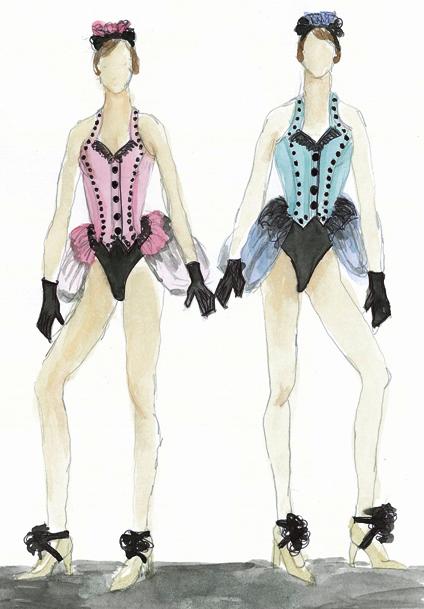
Shown above: Rendering of the chorus girls’ costumes for Crazy for You - Erin’s unique design featured reversible bodices which allowed for quick changes and multiple looks.
Monday, August 2, 2010
Rehearsal
Hi, it’s Alexandra again. This time I’m delving into the rehearsal process. I feel learning a little bit more about the process will help everyone appreciate the shows even more. So I attended a rehearsal of The 25th Annual Putnam County Spelling Bee.I wasn’t sure what to expect from the rehearsals. It turned out to be a different but wonderful experience. When I walked into the gym at Pansophia Academy, the cast was hard at work blocking the day’s scenes. Blocking is the creation and practicing of the movement that is going to happen on stage. As I began to watch their rehearsal, I was quickly surprised by how collaborative the process was. The actors clearly felt free to put in their ideas and usually they would try the ideas out. Erin Tucker, the show’s costumer, was filling in as Stage Manager; she said the rehearsal process doesn’t normally have as much collaboration. She elaborated, saying since there's less dancing in the show Ray Gabica, the director, allows a lot of collaboration.
The blocking seemed to be going at a break- neck pace. Erin said it always goes quickly but it seemed to be going extra fast with this show. The actors and actresses picked up on the blocking in no time. It seemed every time they ran a song, the bold acting choices became bigger and better. Each time they would find a new facial expression or body movement to make their character even more full and rich. Their concentration levels were very high but at the same time they all looked as if they were having fun. I noticed that even when somebody would mess up, the director would just turn and say, “That’s what rehearsals are for, to screw up so you don’t do it in a performance.”
As the rehearsal progressed, I began to wonder when musical director Cheryl Vanduzen receives her music. I was surprised when she said she receives it only about a week before rehearsals start. She spends the first day and half working with the performers on musical notes in their songs. She doesn’t have her first practice with the pit orchestra until Saturday, the end of the rehearsal week. She rehearses with the pit again on Sunday. Finally on Monday, Cheryl will have her first rehearsal with both the pit orchestra and the performers. The cast and crew will continue to work the show for the rest of the week, until the Thursday afternoon opening. Only with the audience in their seats, is the show finally complete.
It seemed crazy to me how actors and actresses could learn a show so quickly. Why, wouldn’t they need an unending amount of practice time? I asked how long each day the cast practices and was very surprised by the answer. The rehearsal day goes from 10 am -1 pm, lunch break 1-2, rehearsal 2-5, dinner break 5-7, and rehearsal 7-10pm. They literally practice all day and are ready in 11 days. It pays off with outstanding performances.
I hope you’ve enjoyed learning about the crazy fast pace of rehearsal. You can think about it when you come to see The 25th Annual Putnam County Spelling Bee. Next time we’ll give you the insight into the quick sewing designers in the costume shop.
Tuesday, July 27, 2010
Who doesn't need a good laugh?

The reviews have been equally glowing. Donald Calamia from Encore Michigan said "I probably laughed more during my two-hour visit...than I have in quite some time!"
You can read his complete review at Encore Michigan
Christopher Tower, Battle Creek Enquirer wrote, "It's very, very funny. If you haven't had a laugh that made your sides hurt in a long time, then "Run For Your Wife" delivers what you need." He concluded his review with [Director Charles] "Burr's genius eye for comic detail and progession make the most of each cast member to create not only the hit of the season, but one of the best shows ever to hit the Tibbits stage." You can read his complete review at The Enquirer
So grab some friends and come to Tibbits. Run!
Monday, July 19, 2010
Run for Your Wife
This is the director's note I wrote for the program:
Ray Cooney is the best current writer of farce in England. He is author or co-author of Move Over Mrs. Markham, Not Now Darling, Two Into One, Out of Order, Funny Money, Caught in the Net and a host of other gleefully low-brow, but tremendously funny productions. His plays have been so successful, that he owns his runs his own theatre in London. Wikipedia--the ubiquitous source now for everything on line--defines his plays perfectly (and I quote): “Cooney's farces combine a traditional British bawdiness with structural complication, as characters leap to assumptions, are forced to pretend to be things that they aren't, and often talk at cross-purposes to hilarious effect.” I agree. He uses all sorts of stereotypes for his own ever spiraling purposes--never letting political correctness stand in the way of a funny joke. Lucky for us we have a superb company of comedians and designers who think "funny." Rehearsals have been filled with laughter--and all of us together can’t wait to bring you: Run For Your Wife.
Friday, July 2, 2010
Set Designer Andy Broomell

Andy’s favorite part of set design is how completely collaborative it is. He likes how all the departments work together so the final product is cohesive. We also discussed how he designs a set when the story doesn’t take place in a specific location such as New York. Andy explained how he uses outside sources for ideas and gave examples from the current production of “On Broadway.” He said the design process usually starts by discussing with the director what he or she envisions for the show. Trinity Bird, the director for “On Broadway,” mentioned wanting to incorporate show posters into the set. While listening to music Andy found inspiration in the album artwork that popped up on his iPod. He took the show poster idea and modernized it by using the CD cover artwork from each of the shows represented in the revue. He also incorporated the exposed light trusses used at concerts. His main goal was to create a versatile set that worked for the multiple songs in the show. When he’s designing he has little involvement with the cast, but he does have to keep their needs in mind.
Alexandra Lyon