Showing posts with label Technical theatre. Show all posts

Thursday, July 28, 2011

Week 2: Behind the Scenes


Hey, it's Paige again! I'm enjoying my second week at Tibbits even more than my first; I didn't think that was possible. I began my second week back in the office, writing another press release. This time, it was for the next Popcorn Theatre show: "Abracadabra Magic Show," featuring different magicians at each performance. Then I helped Lori (special events coordinator) make some business calls regarding business promotion letters she sent out last week. Luckily, the second day a couple businesses said they would love to help support the Tibbits Restoration Project!

On Tuesday I got the chance to sit in on one of the rehearsals for the next Summer Theatre show, "Working" by Stephen Schwartz. I went over to the Pansophia Academy gymnasium to observe the blocking rehearsal for a couple hours. Everything was moving really quickly. The actors were working on something the entire time, whether it was choreography, music, or just memorizing lines. In the two hours I was there in the morning, the cast worked its way through three or four songs. I was really impressed. The actors' voices are amazing. During the rehearsal for one of the full cast numbers I literally got goose bumps as they were singing. I came back to watch some of the evening rehearsal that night, too. By the time I left, the entire first act was blocked! I've never seen such a productive day of rehearsals.

Yesterday was the coolest day, by far. Before the matinee performance of "Out of Order" I got to watch some of the tech run throughs with the window set piece. For those of you who haven't seen the show, throughout the course of the play, the window in the hotel suite randomly slams shut on people, knocking them out momentarily. So I got to watch as each of the actors who encounter the unpredictable window took turns having the set piece fall on them. Mark is in charge of working the trigger release for the window. In addition to that, he has to time the "slap stick", which is two 2 x 4's that have been hinged together. He slaps the two wooden pieces together as the window falls to create the loud sound the audience hears as the window slams shut. When I watched this show last week from the audience, I wondered how the window operated. So watching this run through was really fascinating.

Then I was fortunate enough to get the chance to watch the entire show from backstage! But, not only did I get to watch the show, I also got a headset so I could hear the "headset chatter" between Carrie, the stage manager, and the other techies as she called out cues for lights, sound, and the window. I sat backstage the entire show, beaming from ear to ear. I'm no stranger to being backstage, but sitting through a professional show while wearing a headset was probably the coolest thing I've ever done. Every time an actor walked past me they would give me a huge smile and a thumbs up, just getting pumped up for the afternoon's performance. This experience really got me excited for a couple years down the road when I'm able to partake in professional summer theatre productions like this. The cast put on a great show yesterday, and I couldn't have been happier with my seat.

Tomorrow I'll be back in the box office for the Popcorn Theatre show in the morning, and I'm looking forward to that and the rest of the things I'll be doing to finish up my internship at Tibbits. I've really fallen in love with this institution over the past two weeks and I know that I will return to help out in any way possible for next summer's season!

Thursday, August 5, 2010

Costume Shop

Okay, it’s Alexandra, now it’s time to take you into the costume shop. In my exploration of Tibbits Summer Theatre, understanding where the lovely costumes come from strikes me as another interesting topic to give you a fuller understanding of what you see on stage.

I had no idea what to expect the first time I went to help in the costume shop, it turns out the department has two of the sweetest people I’ve ever met. The sincere and hard working designers making the costumes this summer are Erin Tucker and Theresa Hartman. They are both crazy busy with work this summer. Normally, two designers split the main stage shows and one person gets the children’s theater. This year there are two people for all of the shows.

As I looked about the basement full of clothes, I wondered if they make all of the costumes new for the shows. Theresa said most of the costumes come from existing things that are altered and just a few are made from scratch. Theresa happened to be making a red dress from scratch that day. She said it all depends upon what’s needed and the time they’re given.

With all this work to do, I asked what kind of hours Theresa and Erin work. Generally they work a 9-5 job, but sometimes they come back and work between 7-10 pm. After watching them perform a fitting or two, they were ready to assign me a job. My first job was to sweep the floors. I swept along and every few feet, bent over to pick up the endless amount of dropped pins. I quickly realized even the simplest task wasn’t going to be easy.

Job number two was taking the pile of clothes off the floor and putting them all on hangers. It was actually very enjoyable; it was neat to see all of the different items which inhabit the costume shop. My last job was organizing the wall of purses, clutches and jewelry. This was awesome. I’ve never seen such an array of bags and jewelry. I was up and down off of a folding chair and smiling every minute. My respect for Erin and Theresa grew with every up down on the folding chair.

These two work extra hard during the summer, then go back to school and study for the rest of the year. I had fun in the costume shop and it has been a joy sharing my experiences with you.

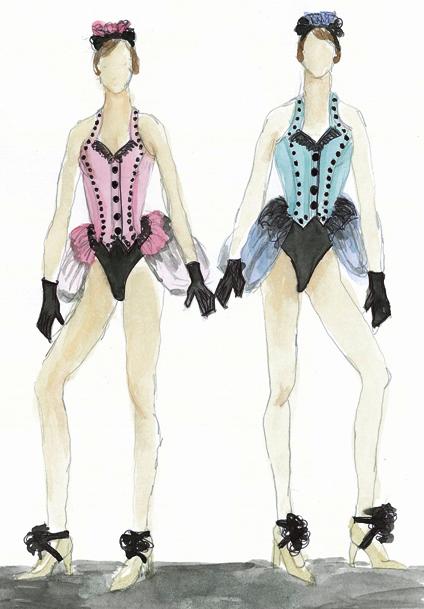
ErinTucker, Costume designer for Crazy for You and The 25th Annual Putnam County Spelling Bee, provided the basic steps to creating costumes for a show:
1. Script reading (understanding the show, the characters, their costume needs)
2. Meeting with the director (learning the director’s vision for the show)
3. Historical research and renderings (understanding and creating a visual base for the costumes)
4. Pulling and building (using the costumes in the shop as a base for creating the costumes and fitting them for each character)
5. Dress rehearsals (Seeing how the costumes work for each character, how they play together on stage, and making minor adjustments)

Shown above: Rendering of the chorus girls’ costumes for Crazy for You - Erin’s unique design featured reversible bodices which allowed for quick changes and multiple looks.

Monday, July 14, 2008

Set Design and Little Women

The Set for Little Women

This is Charles. While Little Women closed a week ago, I thought our audience might like to hear about (and look at) this highly innovative set.

Here is Set Designer Lex van Blommestein talking about his first impressions for the concept of the set:

"When I first read the script for Little Women I realized that it is not as simplistic as some musicals. There is a rich story, that involves other fantastic stories wrapped within. I had to develop a visual idea that allowed for an interesting way to portray the rich and embellished tales that are spinning in Jo March's head. In the end, the decision became clear... bring it back to the story(ies). I had to keep the fantasy alive and interesting without making it seem like it was being acted. Using a semi-transparent material on the walls allowed for the hazy dream like stories of Jo's head to be played, while in front of the walls the reality of the musical can come to life."


These first three images are the preliminary sketches of how the set might work.


Once the set was okayed by Ray Gabica (the director), Lex and the Technical Director, Chuck Griffin, sat down to figure out what kind of materials could be used that would give the set the look Lex wanted but be within the budget for summer theatre. Scrim, the material that allows light through it when lit from the back and opaque when lit from the front, is very expensive.

Lex and Chuck decided to use a much more cost effective cheese cloth that had many of the same properties. It is never as opaque, but since we never had to see a "realistic" wall, it would work well--always giving a slightly ghostly feel to the room. Once the frame was built, the cloth was stretched over it and sized with a mixture of water and glue. Chuck demonstrates the look of the raw flat.


Next, it was Lex's turn to paint. Since the whole play is composed of Jo thinking back over her life, he opted to see fragments of the wall, not a hyper realistic look. Notice how the wall paper stencil fades in and out over the flat. The stencil is cut by hand and used to get the regulated pattern of the wallpaper. In the attic it is a suggestion of the lath showing through the plaster. For the floor he painted large pages of manuscript.


Ray wanted the show to always remind us of Louisa Alcott's (and, hence Jo's) literary roots. Great panels looking like books on a shelf were used to hide the house and provide other locations. Here Charlie Cochran and Chuck hold up the frame before it is covered with regular muslin.


Here is one completed and ready to go to the paint area. The workshop is located in the same building as the paint shop. Our property storage is there, too. The building is located about half a mile from the theatre. It's very convenient---until you need to transport the set to the theatre in the rain.


The platformed area helped define where we were at any given moment in the musical. The highest area was the attic. A sitting room area was to the left that could double in both the house and the boarding house. And an entrance/passageway was to the right of the attic. Here the platforms are just built and put in place for the first time at the scene shop.

Th Designer and Scenic Artist, Lex van Blommestein with the Little Women wallpaper stencil. Lex guesses he spent 55 hours painting the walls, platforms and floor.


Wednesday, July 9, 2008

Room Service Rehearsal, Day Ten

Prior Reports:
Day 1 - Sunday, 29 June: Read-Through and Act One Blocking
Day 2 - Monday, 30 June: Act Two and Act Three Blocking
Day 3 - Tuesday, 1 July: Act Three Blocking, Publicity, and Working Act One
Day 4 - Wednesday, 2 July: Working Act Two and Meet the Cast
Day 5 - Thursday, 3 July: Run-Through and Meet the Cast
Day 6 - Friday, 4 July: Run-Through and Meet the Cast
Day 7 - Saturday, 5 July: Work Session and Designer's Run
Day 8 - Sunday, 6 July: Load-In*, Hang and Focus, and Running Lines
*Including one-minute timelapse video of the set going up!
Day 9 - Monday, 7 July: Costumes, Props, and Adjusting to the Stage


Tuesday, 8 July: Stage Management, Box Office, and Dress Rehearsal

Hi again! I'm Eric Silvertree, a member of the cast of Room Service, the rollicking farce opening Thursday, 10 July at the historic Tibbits Opera House in Coldwater, Michigan.

Time is speeding by as the show gets ever closer to opening. During the morning session, the technical crew - set, lights, props and costumes - were hard at work finalizing all the details, from repairing the facing on a step that one of us accidentally kicked in, to finishing a hat for one of the ladies, to finding the right mix of Coca-Cola and 7-Up to simulate champagne.

The afternoon session was a run without costumes (except for garments changed on stage as part of the show) and in the evening we had another full dress rehearsal. Yesterday, our biggest concern was adjusting to the move from the rehearsal space to the stage. Today, we were back to concentrating on our acting, polishing our performances, and establishing our personal routines for the show. We and the crew all rely on each other backstage to keep things running smoothly. For example, Robert helps Whitney and Sarah by remaking the beds during the first intermission, Brian and Steve help J.R. with a tricky little bit of costuming before he makes a re-entrance, and I help John maneuver the breakfast cart into place so when the door opens, he can wheel it right on.

You've caught sight of the stage management staff here and there in previous posts, but let's get to know them a little better.

In front is Justin Carroll, the production stage manager. Justin started working with Tibbits Summer Theatre five years ago as an assistant, and is now the man in charge when the show goes live and the director turns over control to stage management. Justin is working toward a degree in theatre technology and design at Central Washington University.

Behind him is Whitney Shouse. Whitney is the assistant stage manager for mainstage shows, and serves as primary stage manager for the Tibbits Popcorn Theatre series for young audiences. Whitney is a theatre major at Hanover College in Indiana.

At the lighting control console in back is Ben Paciorkowski, the master electrician. From this nest off to the side of the stage, Ben and Whitney perform the technical aspects of the show - raising the curtain, ringing the telephone on the set, controlling the lights on stage and in the auditorium - while Justin gives them their cues from his post in a booth behind the last row of seats in the balcony. Justin, Whitney, and Ben are in constant communication by headset microphone, and Justin also makes announcements to the actors thorough speakers in the dressing rooms.

We also have dedicated folks keeping things going at the Tibbits year-round. Joan Spaulding is the darling lady in charge of keeping things tidy throughout the building. Cleaning our individual dressing room spaces is each actor's responsibility, but then there's the auditorium, the lobby, the downstairs intermission space with art gallery and gift shop…

Dave Brown is the house technical director, making sure the lights and fans work for us on both floors of dressing rooms, for instance, as well as working with the community theater and other performance groups that use the opera house when Tibbits Summer Theatre is not in season. I never know when I'm going to come across either Joan or Dave when I zip through the place at random odd hours, and Joanie always has a sweet smile and a laugh for me, and Dave's always ready with a new joke.

There are a lot of people involved in mounting a production - not just the actors you see strutting their stuff in the light. We all work hard to bring the show together - and by now, I hope you're as eager to see the production as we are to present it. Here are the friendly people to talk to for tickets!

That's box office manager Jo Summitt on the left, with assistant manager Vanessa Bloom on the right. In the second photo are Shannon McKinney and Sam Haberl.
They'll be very happy to reserve your seats - either in person, or at 517.287.6029. The box office is open from 10am to 5pm every weekday, 9am to 4pm on Saturdays, plus at 7pm (an hour before curtain time) on all dates with evening shows. Room Service opens on Thursday with two shows - a matinée at 2pm and an evening performance at 8pm. We continue Friday and Saturday at 8pm both nights. The following week, we re-open on Wednesday with a 2pm matinée, then complete the run with 8pm shows on Thursday, Friday, and Saturday.

Tomorrow (Wednesday) we have our final rehearsal before we open the doors and bring up the curtain - and your backstage pass with me on the blog will go on all through the run of the show. More coming soon!

Tuesday, July 8, 2008

Room Service Rehearsal, Day Nine

Prior Reports:
Day 1 - Sunday, 29 June: Read-Through and Act One Blocking
Day 2 - Monday, 30 June: Act Two and Act Three Blocking
Day 3 - Tuesday, 1 July: Act Three Blocking, Publicity, and Working Act One
Day 4 - Wednesday, 2 July: Working Act Two and Meet the Cast
Day 5 - Thursday, 3 July: Run-Through and Meet the Cast
Day 6 - Friday, 4 July: Run-Through and Meet the Cast
Day 7 - Saturday, 5 July: Work Session and Designer's Run
Day 8 - Sunday, 6 July: Load-In*, Hang and Focus, and Running Lines
*Including one-minute timelapse video of the set going up!


Monday, 7 July: Costumes, Props, and Adjusting to the Stage.

Hi there! I'm Eric Silvertree, back with another installment of the day-by-day backstage blog of Room Service, part of Tibbits Summer Theatre's forty-fifth season of summer stock.

I'm sure you noticed some props and furniture pieces gradually replacing the folding chairs that stood in for the real things during rehearsals at the Jefferson Elementary School gym. On Monday, however, we got our hands on all the genuine articles we'll be using in the show. Minor additions and changes will continue right up to the final rehearsal, but all the departments try to make sure that the technical aspects of the show are as close to finished as possible for the first on-stage run.

Properties master Sarah Simrau had her work cut out for her - there are three and a half pages of fine print on the last pages of the script, listing the props called for in the action of the play - and none of them are allowed to look as though they were manufactured in the twenty-first century. Period suitcases, doctor's bag, dinnerware, linen and towels, a typewriter in a carrying case - all have to be either found, made, or modified from items in the Tibbits stock.

It all looks like a pile of mess as it's brought in, but Sarah and assistant stage manager Whitney Shouse quickly get things organized. Props are either pre-set in the right locations on the set or laid out on tables backstage, with a specific place for each prop, so that we actors always know exactly where everything is and can easily grab what we need and get back on stage.

Lights and set also have some details to attend to, like wiring the lighted sconces attached to the wall above the side tables by the beds. Here you can see Whitney and master electrician Ben Paciorkowski hooking up power to a bell ringer that has the right sound for a 1930's telephone and can be controlled from the light operator's station.

During the morning session, while the crew was busy working on the stage, the actors met in the greenroom. Nobody can agree on why the room set aside for actors to relax offstage as they're waiting to go on is called the greenroom, but it's been called that since at least the beginning of the eighteenth century. Ours is down a flight of stairs from the door opening onto the back of the stage, and it's the perfect spot for the whole cast to go through the dialogue of the whole show from beginning to end, talking our way through the script one last time before we start doing it on a set with stairsteps and doors and furniture and props in our hands.

After lunch, we walked around on the set for a few minutes to get used to the space, and then we began our first onstage run-through. We've been rehearsing on a flat floor without walls up until now, pretending to be holding papers and dishes and things, so we were all a little distracted the first time through, and kept forgetting our lines. That's not a problem - the director expects it to happen, and so do we. When an actor goes blank in rehearsal, he or she doesn't (and shouldn't) waste time apologizing for it. Instead, we just shout "Line!" Someone - usually Justin Carroll, the stage manager - has a script right in front of him, ready to feed us a few words to get us back on track. There comes a point, of course, when we're expected to recover from problems on our own (since we can't shout "Line!" during a performance) but that point doesn't come until we've had a chance to get used to the stage.

For the evening session, we added costumes to the mix. We've paid individual visits to the costume shop for fittings at various times during the last week, but this was our first time wearing them for a dress rehearsal, or rehearsal in costume. Getting used to our clothes, and when we change them for different scenes, is another distraction, but we all settled in very quickly. In fact, I think I was the only one who called "Line!" during the evening dress.

Costuming a show set in the 1930's - or any other historical period - presents the same challenges as gathering props. All the garments have to have to be in the right style, with no obvious color or fabric choices from the wrong era. Some of the clothes are simply pulled from the Tibbits inventory, and some are constructed from scratch. Let's meet the costumers!

In front is Melissa Swanson, the designer for Room Service. Behind Melissa is Kathleen Reid, and behind Kathleen is Em Rossi. Kathleen recently earned her BFA at the University of Central Missouri, and Em is working toward her MFA at Wayne State University. They all share the work as stitchers for every show, but they divide the design responsibilities up. Em designed Little Women, which just closed, and is working on the upcoming show The Goodbye Girl, which follows Room Service. Melissa will design again for The Bop She Bops, and Kathleen is in charge of all the shows in the Popcorn Theatre series for children.

Now that we're on the stage, and into the dress rehearsal phase, we're almost ready to open. Tuesday and Wednesday will be our time to work out the last of our hesitations and uncertainties as we prepare to open the show to the public on Thursday. I'll talk to you again soon!

Monday, July 7, 2008

Room Service Rehearsal, Day Eight

Prior Reports:
Day 1 - Sunday, 29 June: Read-Through and Act One Blocking
Day 2 - Monday, 30 June: Act Two and Act Three Blocking
Day 3 - Tuesday, 1 July: Act Three Blocking, Publicity, and Working Act One
Day 4 - Wednesday, 2 July: Working Act Two and Meet the Cast
Day 5 - Thursday, 3 July: Run-Through and Meet the Cast
Day 6 - Friday, 4 July: Run-Through and Meet the Cast
Day 7 - Saturday, 5 July: Work Session and Designer's Run


Sunday, 6 July: Load-In*, Hang and Focus, and Running Lines
*timelapse video

Hello again! Eric Silvertree reporting from the Tibbits Opera House in Coldwater, Michigan, on all the preparations here for our production of Room Service, the classic 1937 comedy by John Murray and Allen Boretz.

After the Saturday designers' run came the final performance of Little Women. Once the audience had gone home and the actors changed out of their costumes and cleaned off their makeup, it was time to strike the set. To strike something is to move it off the stage, and everybody in the company - even those not otherwise working on a particular show - participates in strike at the end of a show's run. Chuck Griffin, our technical director, is the man in charge at strike, and under his well-organized leadership, we had the Little Women set dismantled, piled on a trailer, trucked over to the scene shop, and unloaded in just a little over an hour.

Of course, we were all pretty tired at the end, but we were in a very good mood, because earlier that afternoon at the end of the designers' run, our director for Room Service, Charles Burr, had announced to the cast that he was making a change in the schedule. Because the show is so fast and takes so much energy to perform, and because rehearsals had been going so well, he'd decided to give us the whole day off on Sunday! After a few seconds of stunned silence, we all cheered. Imagine playing tennis or basketball flat-out for three hours at a time, two or three times a day, for a whole week, and you'll have some idea how most of us were feeling Saturday night - even before we started striking Little Women.

I spent a leisurely Sunday morning at the laundromat, and then a few of us who have a huge amount of dialogue (or have been memorizing more than one show at a time) got together on the front porch of the company house to spend a few hours running lines. Running lines is something actors do on their own time. One actor, or a helpful friend, will hold the script and follow along while the others practice. The book-holder will read any parts that belong to an actor who isn't there, and will interrupt the rest of us if we skip a line or make a mistake. We concentrate purely on the words, without worrying about movement, emotion, or delivery. It's a very intense memorization technique, even more focused than working a scene. If one of us keeps getting stuck on a particular line or two, we may do that half-page over and over dozens of times until it's perfect.

Meanwhile, on the stage, Chuck and Lex were overseeing the rest of the load-in process. Load-in, for a set, is the opposite of strike. Let's meet the fine folks on the set construction crew.

Chuck Griffin, the technical director, is in the center, and Lex vanBlommestein, set designer, is all the way to the left. Kyle Garrelts, our technical theatre intern, is standing between Lex and Chuck. Kyle starts working on his BFA in technical theatre this fall at the University of Wyoming. The gentlemen on the right are Charlie Cochran, carpenter, and Chris Otwell, master carpenter. Charlie has a degree from ITT in Phoenix, Arizona, and Chris is working toward his MFA at Wayne State University.

The set was constructed and pre-painted at the Tibbits scene shop, and we carried all the pieces of Room Service in and stacked them against the back wall during the Little Women strike. On Sunday, it was time to put it all together. Thanks to Chris, we have a series of photographs taken at five-minute intervals, enough to make a short video showing the construction of Room 920 at the White Way Hotel in Times Square, New York City.


^ ^ ^      Click the play button above to watch the video

Once the set is up, it's time for the lighting crew to work their magic. Lights for theatre are referred to as instruments, and each instrument needs to be hung in place, aimed, and focused to make sure both the actor's faces and the entire set are clearly illuminated, without unwanted shadows, hot spots, or gaps. The color of the light is controlled with gel, sheets of colored heat-resistant plastic held in frames in front of each instrument's lens. Even shows without visible color effects have a gel in every light.

That's Kat Lanphear, lighting designer, on the left, and up on the ladder adjusting an instrument is Ben Paciorkowski, the master electrician. Ben has a BA from Hanover College, and starts working on his MFA at Purdue this fall. Together they test each instrument, individually and as part of the complete lighting scheme, until the whole setting has the right atmosphere for the show.

On Monday, we actors get our first chance to rehearse on the actual set. More about that, and about the props and costumes for Room Service, in my next report. So long for now!

Sunday, July 6, 2008

Room Service Rehearsal, Day Seven

Prior Reports:
Day 1 - Sunday, 29 June: Read-Through and Act One Blocking
Day 2 - Monday, 30 June: Act Two and Act Three Blocking
Day 3 - Tuesday, 1 July: Act Three Blocking, Publicity, and Working Act One
Day 4 - Wednesday, 2 July: Working Act Two and Meet the Cast
Day 5 - Thursday, 3 July: Run-Through and Meet the Cast
Day 6 - Friday, 4 July: Run-Through and Meet the Cast


Saturday, 5 July: Work Session and Designer's Run

Hello! I'm Eric Silvertree, a member of the acting company with Tibbits Summer Theatre in Coldwater, Michigan, bringing you yet another backstage report on the rehearsals for Room Service, the mile-a-minute comedy opening this Thursday, 10 July.

This is the end of the first week of rehearsal, and also the opening morning of the other show I'm acting in at the moment. The Tortoise and the Hare and Other Fables by Aesop is part of Tibbits Popcorn Theatre for young audiences. The Popcorn shows are performed on Friday and Saturday mornings at 10am. Because of the holiday, the theater was dark all day yesterday - which means there were no shows scheduled. Also because of the holiday, our audience for Aesop was relatively small. A little over a hundred kids came to see the show, which was pretty much what we'd expected.

Besides the free popcorn and juice during intermission, Popcorn Theatre shows feature a meet-and-greet after every performance, where the audience can get autographs and their parents can take pictures of them with the cast. With a small audience, the reception went by quickly, and I was able to make it to the morning Room Service rehearsal before it was halfway over. When I got there, we were in the middle of working Act 3.

The afternoon session was the designer's run. The heads of all the technical departments were in attendance for a complete run-through of the show. The designer's run is a final check for props, costumes, lighting, and set, so that they know - for example - whether a water pitcher on stage will actually need water in it or not, and which corners of the set need to be lit for actors' faces, and which just need lighting for atmosphere.

We'll be moving onto the actual set on Monday, and although there are always a few minor surprises and hiccups when we make the transition, all the departments (including the actors) do everything they can to make the transition as smooth as possible. You've met the cast. Let me introduce you to the designers.

First, on the left, is Sarah Simrau. Sarah is the properties master. Properties, or props, are any objects in the show which are moved or handled by the actors. In Room Service, that includes things like luggage, newspapers, champagne bottles, a stuffed and mounted deer's head, a serving cart of real breakfast for three of the actors to wolf down on stage, and much much more. Sarah has a theatre degree from Mid-Michigan Community College, and interned at the Florida Studio Theatre before joining the staff at Tibbits.

Next is Lex vanBlommestein, the set designer. Sets are anything on stage that doesn't get moved around. The walls and doors are part of the set, of course, but so are the furniture and decorative objects arranged on them. Lex holds an MFA in scenic design from Wayne State University, and is soon to take up a professorship at Southern Illinois University.

Moving on, we come to Melissa Swanson, costume designer. Costumes, obviously, are the clothes that the actors wear on stage, but her department also covers things like the actors' hair and makeup styles. Melissa is a student at Western Illinois University majoring in both art history and costume design.

And on the right is Kat Lanphear, the lighting designer. In addition to the lights for the show, her department has a hand in anything on stage that requires electricity and remote control. Kat has a degree from Alma College, and is working toward her lighting design MFA at Wayne State University.

The boundaries between these departments are not rigid. Lex and Sarah collaborate on the knickknacks that dress the set. Sarah and Melissa work together on the items of clothing that aren't actually worn but are tossed around as props. Kat and Lex consult on the light fixtures mounted on the walls in the room. And, of course, they all work together with the director to make sure that the actors look the way he wants them to in their costumes on the set when they're lit and carrying props.

My next report will be a closer look at the stage as the set goes up and the lights get focused on Sunday. Be back soon!

Thursday, June 26, 2008

How to Build a Hundred Acre Wood

Here is Popcorn Theatre Designer Christopher Otwell's white model for The House at Pooh Corner. The play, adapted by Bobb James, travels to many places in the Hundred Acre Wood. This is the model Chris brought to the first production meeting to show the director, Trinity Bird, how the set might work. This is a composite of all the pieces used in the show. They don't play on stage at the same time. Those who saw the show will notice that this rough idea for Eeyore's house changed.
The map, taken from the fly leaf of the book, is the connecting link for all the locales. Here is the muslin stretched and ready to paint.
Here the color is just beginning to be added.

The completed map still at the scene shop. Chris estimates that the map alone took about 15 hours to paint.

The completed map in place, with one of the the small bush pieces. The House at Pooh Corner plays thorough the 28th of June.

Thursday, June 5, 2008

How Summer Theatre Comes Together, Part 2

I start to find the Design/Technical side for the summer at the same time in February as the acting auditions. There is something like a jobs fair at each audition I attend. Designers arrive at the Tibbits table with portfolios of their work--pictures, prompt books, technical drawings, renderings--hoping to impress the theatre representative. (Sometimes this is me, sometimes the Technical Director, if I have one in place that early in the season.) I also do a tremendous amount of our technical hiring from backstagejobs.com where countless behind the scenes jobs are listed for theatres across the country.

This year we have a very high return rate on the technical side. I think this speaks well for what we do here. It is an exhausting, sometimes thankless job. But we had a great team last summer and have only built on our strengths for this one. Lex vanBlommstein and Em Rossi, both in the process of getting their Master's degree with the Hillberry, are back with us. I know they were instrumental in talking up the Tibbits there, so we have three others from that program working here this summer.

The Design/Tech staff has all been here a week. The set is already being built. The Technical Director feels they are a couple of days ahead of schedule for Little Women and it has been given to the Scenic Artist to paint. The Costume Department is deep in research and showing renderings of the various ideas to be approved by the Director. The Properties Department is making massive lists and doing their own research of the Civil War era. Lighting is reconditioning lights and hanging them in a rep plot-- that is where the basic hang will be used all summer with variations for each show.

We have also been rehearsing Grace and Glorie and The House and Pooh Corner. By the end of the day we will be rehearsing three shows in three spaces around town. I will post this now, for it's time to greet the vast majority of actors who are arriving for Little Women. By the end of this week the first two productions will be open. That fact can still amaze me.